Heather on her travels |

| Date palms and donkey carts – things to see in Siwa Oasis in Egypt Posted: 24 Sep 2011 10:33 AM PDT  When I heard about the oasis at Siwa in the Egyptian desert, I visualised of a small patch of palm trees waving in the breeze, a few mud brick houses in the background and pools of water bubbling up gently from the earth. It was that image from old movies of the oasis in the desert, a halucination that shimmers in the heat but is never quite reached. What I hadn’t realised until we drove across the desert on the excellent tarmac road from Marsa Martrouh is that Siwa is a large town of 25,000 people with a bustling central square, two freshwater lakes and plantations of date palms stretching into the distance. You could see all the major sites in two or three days, but there’s a seductive quality to Siwa that makes you want to slow down and just chill out, absorbing the relaxed atmosphere of the oasis. 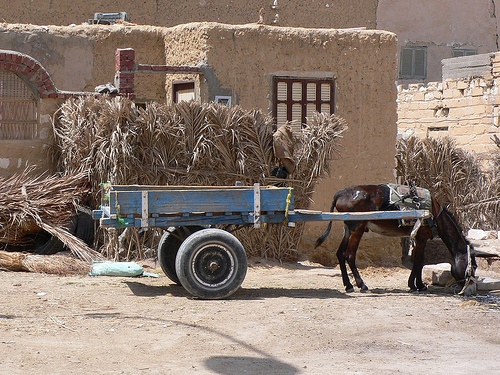 Donkey carts in Siwa oasis in Egypt Because of its isolated position in the middle of the desert, Siwa has developed a unique culture that is different from the rest of Egypt with it’s own Siwi language and traditions. Siwi women are fully covered when they go out of the house and you’ll normally see them being driven around town, sitting wrapped up on the back of a donkey cart that is driven by a husband or young boy. There are numerous springs around the oasis that have been made into walled pools where you can sometimes swim, although ladies need to cover up to avoid causing offence. I visited Siwa with a friend who lives in Alexandria and we so we were so seduced by Siwa that we stayed a day more than intended. Here are things we enjoyed while in Siwa; Take a donkey cart rideYou can find a number of donkey carts waiting like taxis in the central square to take you around the lanes of Siwa and it’s an ideal way to travel on the narrow dusty roads. I didn’t have the opportunity to try a donkey cart ride as we had a car, but your accommodation will be able to arrange a donkey cart tour with a knowledgeable guide who can also tell you about everything that you’ll see on the way. Alternatively go to the square and agree your price for a ride around town. The Temple of the OracleThis temple complex is crumbling away but you can climb up through the mud brick building to the remains of the temple, set on the top, where you can see the stone pillars and carved reliefs. The temple was built in the 6th century and was dedicated to the God Amun. The Oracle of the temple was famous for being visited by Alexander the Great in 331BC, when having done much of his conquering he came to consult the Oracle and confirm his legitimacy. Without a guide it’s difficult to imagine the bustling complex, halls and holy sanctuaries, but you get a great view over the oasis from the top. 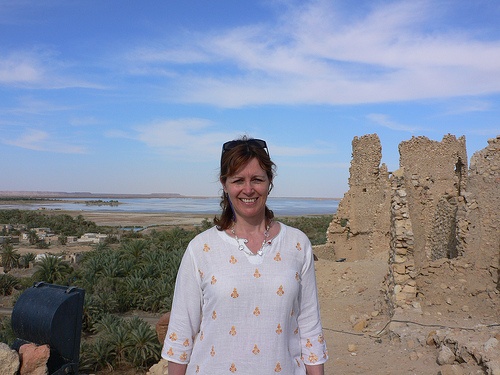 The Temple of the Oracle in Siwa, Egypt Cleopatra’s springThis is the largest and best known spring in the oasis and an ideal place to while away an hour or two in one of the small cafes, under the shade of the date palms, sipping a mint tea. Of course, it’s named after the Queen of Egypt, who probably never came here, but it’s nice to imagine her enjoying a cooling dip amongst her handmaidens. 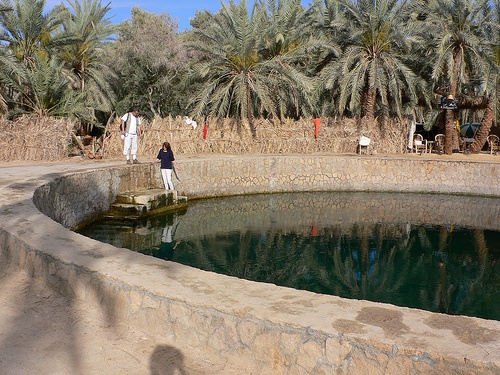 Cleopatra's spring in Siwa, Egypt There are some souvenir stalls there and we were even brought a dish of small local fruit the size of a cherry but with the taste and texture of an apple. There are steps down into the pool, if you fancy bathing like a queen, but the advice for ladies is to bathe covered up with a loose garment and certainly no bikinis.
The Shali FortressThe Shali is the old fortified town of Siwa, build in the 13th century of mud brick mixed with salt rock, known as karsheef, which is hardened by the sun. Originally there was only one gate in to the hill town, so that the Siwa population could be protected from nomadic raiders and control the admittance of any outsiders. In the 19th century, families started to move away from their houses in the Shali and it was further abandoned after three days of heavy rain in 1926 reduced many houses to ruins. Now the Shali has crumbled into a lunar landscape of broken down mud walls, but you can climb up to the top through the old houses that were once filled with families and get a great view over the town. From the top you can see that some of the houses in the old quarter have been restored and are being used as hotels or private homes where you can stay for the authentic Siwa experience. Standing at the top with the wind blowing it seemed like an alien landscape from another planet where you might come across a character from Star Wars or Doctor Who. 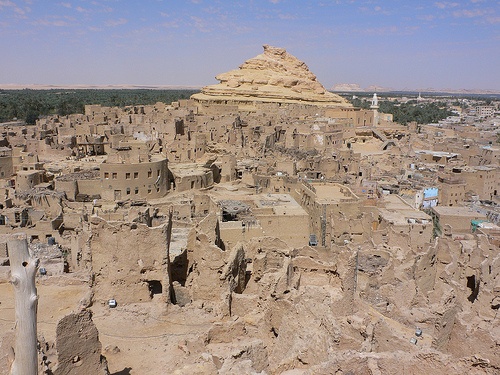 The Shali Fortress in Siwa, Egypt Gebel al-Mawta (The Mountain of the dead)On the edge of Siwa, this outcrop is the ancient burial ground of the Romans and Ancient Egyptians and is honeycombed with empty tombs. It’s possible to climb to the top of the of the mound and sit there with the wind blowing through your hair with panoramic views over the oasis. There is a small kiosk at the bottom of the mound where you pay your entrance fee and this will also allow you to see some of the tombs carved out of the rock which are beautifully decorated with wall paintings.  Gebel al-Mawta in Siwa, Egypt Sadly, no photographs were allowed inside the tombs but it was interesting to see the rock carved pillars and ancient Egyptian paintings.
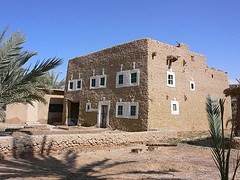
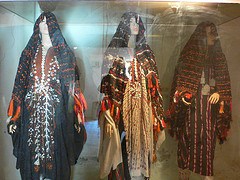
The House of Siwa Museum (El Beit El Siwa)We were lucky enough to have tour in English from the Curator of the Siwa House museum. Although the museum is open at specific times, it’s best to ask your hotel or the tourism office to telephone ahead to book a time to visit, so that you can be sure to find someone to explain everything about the house. The house was constructed specially to house the museum, using traditional Siwa construction techniques using the karsheef mixture of mud and salt rock, with palm trunks to make the beams of the house. Downstairs there is a display of traditional bridal dresses, made of different coloured silks decorated with embroidery and mother of pearl buttons; dark green for the wedding night, creamy white embroidered with the rays of the sun for the 3rd day after the wedding when the bride’s relatives come to call and black for the visit of the bride’s mother 7 nights after the wedding. Upstairs are other traditional costumes and furnishings as well as jewellery and household objects used in Siwa.
Sunset at Fatnas islandThis small island on the salt lake is reached along a causeway road and the favourite time to visit is at sunset, when you can sit under the rustling date palms and watch the sun go down behind the rocky outcrop across the lake. Apparently the lake level has fallen somewhat in recent years, so that now the water in front of the island is full of reeds and the land more exposed. At the place where the road reaches the island there is a small walled spring which is very deep, where you can swim if you wish (ladies remember to cover up) or you can just peer in to the green depths and be mesemerised by the tiny bubbles of gas streaming to the surface. The island is covered with palms and there is a small kiosk where you will be served sweet mint tea while you sit on the wicker chairs and watch the sun go down. When we left the island in darkness, the owner jumped on his motorbike and went home too, and we just had the stars to guide us back to the mainland. 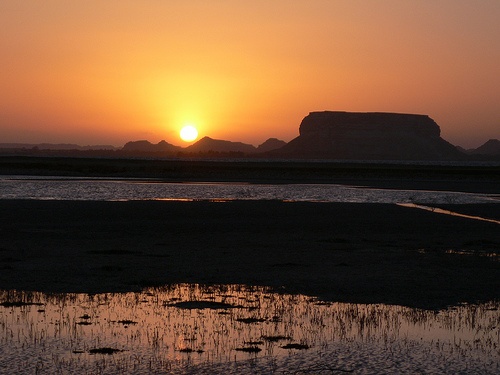 Sunset on Fatnas Island, Siwa in Egypt Our Hotel RecommendationWe highly recommend the Siwa Safari Gardens Hotel where we stayed when we were in Siwa. It is in a very convenient location about 5 minutes walk down a side road from the main square but slightly away from the bustle and very quiet and relaxed. The rooms are on two stories, set around the lovely garden with shady date palms and grass, and best of all there is a small pool which has been made out of one of the natural springs with a stone terrace where you can sit and relax.  Siwa Safari Gardens Hotel in Siwa, Egypt We stayed in the rooms on the upper floor which have an attractive brick domed ceiling and were nicely furnished with colourful quilts and traditional rugs on the floor. There is a pleasant reception/ sitting area next to the dining room where there is free wifi. The owner-manager, Mr Sami once lived in Germany and is exceptionally attentive and helpful – I would trust him to make any arrangements for me in Siwa and he phoned ahead to make an appointment for us with the curator of the Siwa House Museum. I felt that it was a big asset having a pool in our hotel, and such a nice one at that, because here you can swim freely, whereas it would considered disrespectful for women travellers to swim in the springs around the oasis unless they are modestly covered up. If I returned to Siwa I would love to stay here again. Siwa Safari Garden Hotel Website More Egyptian memories 6 misconceptions I had about Alexandria in Egypt
This article is originally published at Heatheronhertravels.com – Read more travel articles at Travel Blog Home You’ll also find our sister blog with tips on how to build a successful travel blog at My Blogging Journey
Enjoy amazing Egypt holidays with Direct Holidays. For great deals and guaranteed low prices, book online today! Powered by Max Banner Ads
|



| You are subscribed to email updates from Heather on her travels blog To stop receiving these emails, you may unsubscribe now. | Email delivery powered by Google |
| Google Inc., 20 West Kinzie, Chicago IL USA 60610 | |
No comments:
Post a Comment